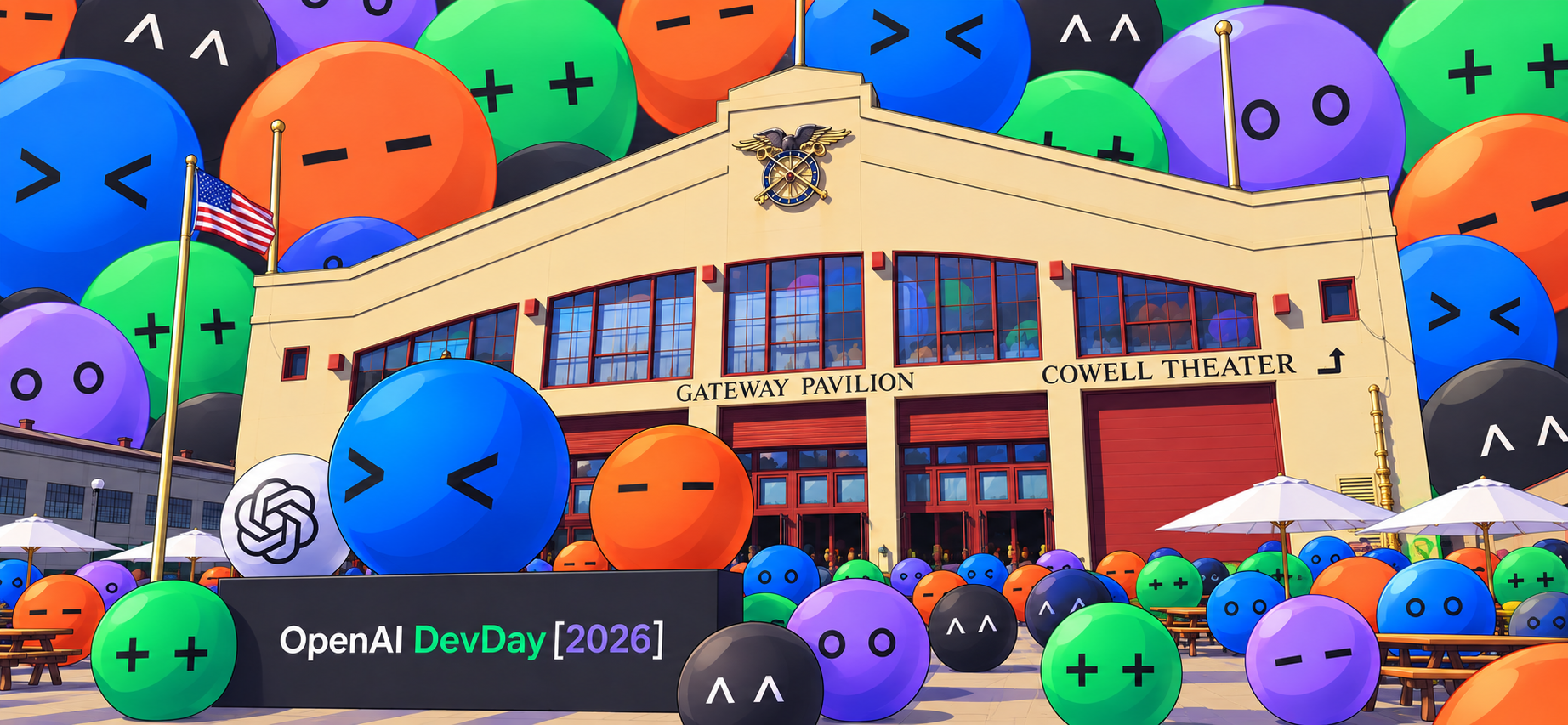
In 2022, I saw the announcement of OpenAI’s DevDay come around, decided that it wasn’t practical this year and that I’d plan to go next year. Then I repeated that for the next two years. But not this year. This year, I finally submitted an application, anxiously waited for approval and booked tickets to San Francisco to get the latest news on ChatGPT, Codex and OpenAI’s products and network with other AI enthusiasts.

In the past, I’d attended PyCon, AWS Re:Invent and DefCon along with some smaller conferences. AWS Re:Invent is the one most aligned with my day job while PyCon got me excited about programming and possibilities in the first place. Still, the last time I was at PyCon, agentic coding was becoming a thing and I felt like it was a bit disconnected from what I was becoming excited about. I think DHH’s recent keynote at RailsWorld probably hits a similar feeling. I started coding when Javascript frameworks were all the rage and haven’t used Ruby on Rails, but seeing the creator of a framework give a keynote telling people to switch to other languages and rely on AI for the coding understandably angered a lot of people who flew out to a conference to learn about a specific language and framework. Still, when at PyCon, I felt like vibecoding was starting to ruin the appeal of a language focused conference. I think I even mentioned to someone that I wondered if we’d switch to a new language that was the most efficient for computers to use without caring about human readability.
OpenAI DevDay was a fresh experience this year and probably the one I needed. Honestly, it’s more of a one day marketing event than a conference, but it felt like being at the center of the world for a day. For someone who mostly works remotely, it was enjoyable hearing the constant talk about people’s vibecoding workflows in line and it was a bunch of people thinking about the same things I am. While I’ll still be exploring different conferences and likely finding my new go to events as technology and coding evolve, this was a good event to come back to.
I arrived at DevDay right at 8, walking 20 minutes from my hotel to Fort Mason.

It had been awhile since I was in San Francisco and it was nice seeing the waterfront. After checking in and getting my badge, I was greeted with what I would know almost 2 hours later as Dots, but for now was just thinking of them as a funny conference mascot. My badge had a blue Dot, with > < eyes, while other people’s badges had different Dots.

This was an observation first noticed in line to get a Honey Lavender Latte, which was rather good.

In general, the conference food here was pretty good. Breakfast had Bacon egg and cheese bites, avocado toast and coconut chia pudding which I ate happily.

The main expo was closed before the keynote, so at 8:30, I got into line to hopefully get a good view of Sam Altman’s keynote.

Within an hour, we were let inside to get stickers of the still unrevealed Dots and to take our seats. I sat a while, talked to the people next to me, then sat a little longer. Every few minutes, there would be an interesting animation of the Dots on the screen.
Finally, it was time for the keynote where Sam Altman took the stage

And introduced Dots

As someone who tries to keep up with the latest in AI, it was really neat to see the announcements live. Having been surprised by how quickly Astra was eating up credits, hearing that GPT 6.1 Sol would be 1/5 the cost with pretty much the same performance was immediately appealing. I can’t see myself ever using Ultrafast at 6x the cost however. Spaces seemed like a new way of organizing projects and with Pages seemed a lot like Notion built into ChatGPT. I just heard of JEV over the last week, heard people talking about it in the line to get in and the Decisions API seemed like OpenAI’s answer already. Sadly there was no new frontier model announced and all of the announcements seemed like OpenAI’s version of an existing project, though I may come to like their inclusion into ChatGPT.
Like most, I’m most excited to try out Dots. While Claude Code and Opus 4.5 felt like they brought AI assisted web development to another level, this felt like an improvement of the agentic coding tools like Cursor and Windsurf. In comparison, the launch of OpenClaw seemed to make a powerful AI assistant a reality. It could search websites, check emails and seemingly do anything if you configured it right. You could text it on different channels, people were setting up ways to call it. It seemed like the ultimate AI assistant and the use cases were endless. My main concerns were security and polish and I was excited to see what would become of it.
While I try to keep up to date with things, admittedly I haven’t yet used Hermes, GrokBot or the recently launched Muse, but am very excited to try out Dots. As I mentioned earlier, the launches all seem to be OpenAI’s version of something or another which was a little unexciting. But practically, I do find myself coming back to OpenAI’s products and experience. Grok’s initial search capabilities made that my usual go to for awhile, but ChatGPT got it working and got me back into mainly using ChatGPT. The initial suite of tools such as Cursor, Windsurf and eventually Claude Code would pull me away but eventually I found the merging of ChatGPT and Codex into a single app to be my preferred experience. One of my favorite use cases for Coding with OpenClaw and connecting different models was that I could have the agent generate images with Dall-E and incorporate them into the app it was building. It’s amazing how long it took, but finally ChatGPT/Codex can do that natively without configuring another API key, removing some of the appeal of OpenClaw’s multi model configuration.
Still, some of the assistant capabilities of OpenClaw have left me missing something when I’m using ChatGPT primarily. I feel like ChatGPT adds a bit more trust and polish, I wouldn’t trust OpenClaw with financial knowledge or an email account that wasn’t created specifically for it, but if I trust Google with my mail, I don’t know that I feel differently about Open AI. Give it some read only access in ChatGPT finances and emails and I don’t need to check my credit card statements to see what credits I still have available. I can message ChatGPT to ask if I have Hilton, Resy, DoorDash credits available based on statements and email messages and have a single place to get information I’d need to find in multiple places. Ultimately, that trust led me to use ChatGPT more as an assistant than OpenClaw, even though OpenClaw had more built-in assistant capabilities. With Dots, I hope to get back the assistant-like AI that OpenClaw provided while using the integrations and information that I wouldn’t have trusted it with.
Most of my discussions around AI tend to be productivity focused, but finally, there was one announcement that my mind keeps coming back to. That announcement was that everyone in the audience would get a Gameboy (a ModRetro Chromatic).

Initially, I thought this would be something they put together, like a DefCon badge, but no, ModRetro is a company which makes pretty good hardware and it seems like a regular Gameboy. This came along side the announcement that Codex would be integrated with it so that we could code our own video games. As a 90’s kid who’s first game was Pokemon Yellow and put 100’s of hours into his Gameboy Color, I really want to make a game. After the keynote, the rest of the event opened up. The main expo opened and there would be three different tracks going on at a time.
Due to the setup in Fort Mason, talks were split across four locations. Festival pavilion was a large building which hosted the keynote and closing Q&A and had videos and speakers throughout so you could see and hear throughout the building without issue. The other building for the event was the Gateway Pavilion, which hosted the expo, the Cowell Theater, which was an auditorium used for talks, and the Mezzanine Stage.

There was also an outdoor stage where some talks were held. As opposed to a room of a bunch of different sponsors, the expo area is demos of different products and features of ChatGPT.


There were people showcasing it’s voice mode, Codex, Ultrafast and more and honestly, as someone who uses it regularly, I didn’t do much here. We were able to design a Dot and print a sticker out but ultimately while the expo area is often the highlight of many conferences, here I found it lacking compared to talking to other attending attendees or attending some of the talks. There was a small museum like exhibit about people who built with Codex which was a neat idea, but didn’t land for me in execution.
Unfortunately, while talks were split across four stages, only two of them had good audio. If you were in the Festival Pavilion, you could sit anywhere in a massive building and see the talk. Similarly, the Cowell Theater had a lot of seats and good audio. The Mezzanine Stage and Outdoor Stages were small areas of gathering areas, with the Outdoor section and upstairs at the expo both used for lunch, beverages, etcetera and unless you close to the speaker, you wouldn’t be able to hear what was being discussed. These were less stages and more corners of areas and with the large crowds at the conference, ultimately while there were a couple talks I wanted to attend, I didn’t arrive earlier enough to get a good spot and went to the other locations.
For the first session, after walking around the expo, I tried to attend the talk “What Comes After Loops? Deep Dive into Agentic Architecture,” but that was at the Mezzanine Stage, so I just checked out the expo, got lunch (mac and cheese, jerk chicken slider and a salad) and arrived at the noon talk early. The OpenClaw craze was one of the most exciting times in AI for me, so I had to go to the Festival Pavilion for the talk on Claw Labs: Building Open Source Together to see Peter Steinberger talk about OpenClaw and running it at Open AI.

This was a fun talk and it was cool seeing how someone who made AI more usable, leading to things like Dots and Muse, uses almost as teammates. It was also fun seeing the sillier aspects like making an old timey newspaper of events within OpenClaw’s projects.

It does seem that OpenClaw is being kept around as an OpenSource offering within OpenAI and with things like OpenClaw Enterprise and other upgrades, it’s definitely working on fixing early security concerns. I was a huge fan of OpenClaw and not having tried Dots yet, I still find myself missing aspects of it as I use ChatGPT/Codex for more projects. I was a little surprised that after the hour and a half I waited earlier, I was able to get a third row seat 8 minutes before the talk, though the room did fill up decently well by the talk.
After that, the line for merch had finally died down enough for me to brave it. I’m always happy to get a hoodie and the keychain/stickers were surprisingly good quality. Most surprising was the GameBoy / ModRetro Chromatic. I had expected something DefCon badge-like, but from what I can tell it seems to be a better quality recreation of the original Gameboy and the Codex branding makes it all the cooler.

After this, I attended the Codex Game Studio talk which discussed the history of humans and games, humans using games to test AI and finally the focus of the talk which was using AI to write games with Codex, tying in with the promotion of the ModRetro. The most exciting part of this talk was probably seeing Casey Neistat who moved 3 feet from me to film and I couldn’t resist asking for a selfie.

After grabbing a matcha from the coffee stand, I went to a talk in the Cornell Theater on Codex’s move to the cloud. I’m definitely guilty of carrying my open laptop around so that Codex continues to run whatever task it’s running. Being able to run tasks in the cloud will be a definite quality of life improvement and is another thing I miss about using OpenClaw on a server as opposed to using Codex on the laptop. After this, the main event would start to wind down. I walked around a bit, talked to a few people and came back for the end Q&A. After that was a reception where I got some snacks and a drink, talked with other attendees and OpenAI staff and asked Matt Wolfe, producer of AI News of the Week which I’ve been watching weekly for the last couple of years.

From there, it was time to head to the airport and go back to Boston.
All in all, I really enjoyed this event. It was definitely more of a marketing event that the conferences I usually attend with one company as the sole focus. Even the expo hall at Re:Invent which is focused on AWS features a lot of different companies and has a larger variety of talks by them and how they use AWS. Understandably, this is a much smaller event with (I believe) all talks done and the whole expo consisting of OpenAI staff. In a way, this felt a bit like being in an Apple store. It was awesome to be at what is probably the most exciting AI event of the year, seeing and meeting the people behind ChatGPT and Codex, and talking with attendees who are excited about the potentials of AI and hearing about what they use it for. As someone who has been immersed in this world for awhile, hearing the non-stop vibe coding and AI discussion made me feel in my element. Thanks to everyone involved for the great event and I look forward to looking for more like this in the future.


Leave a Reply